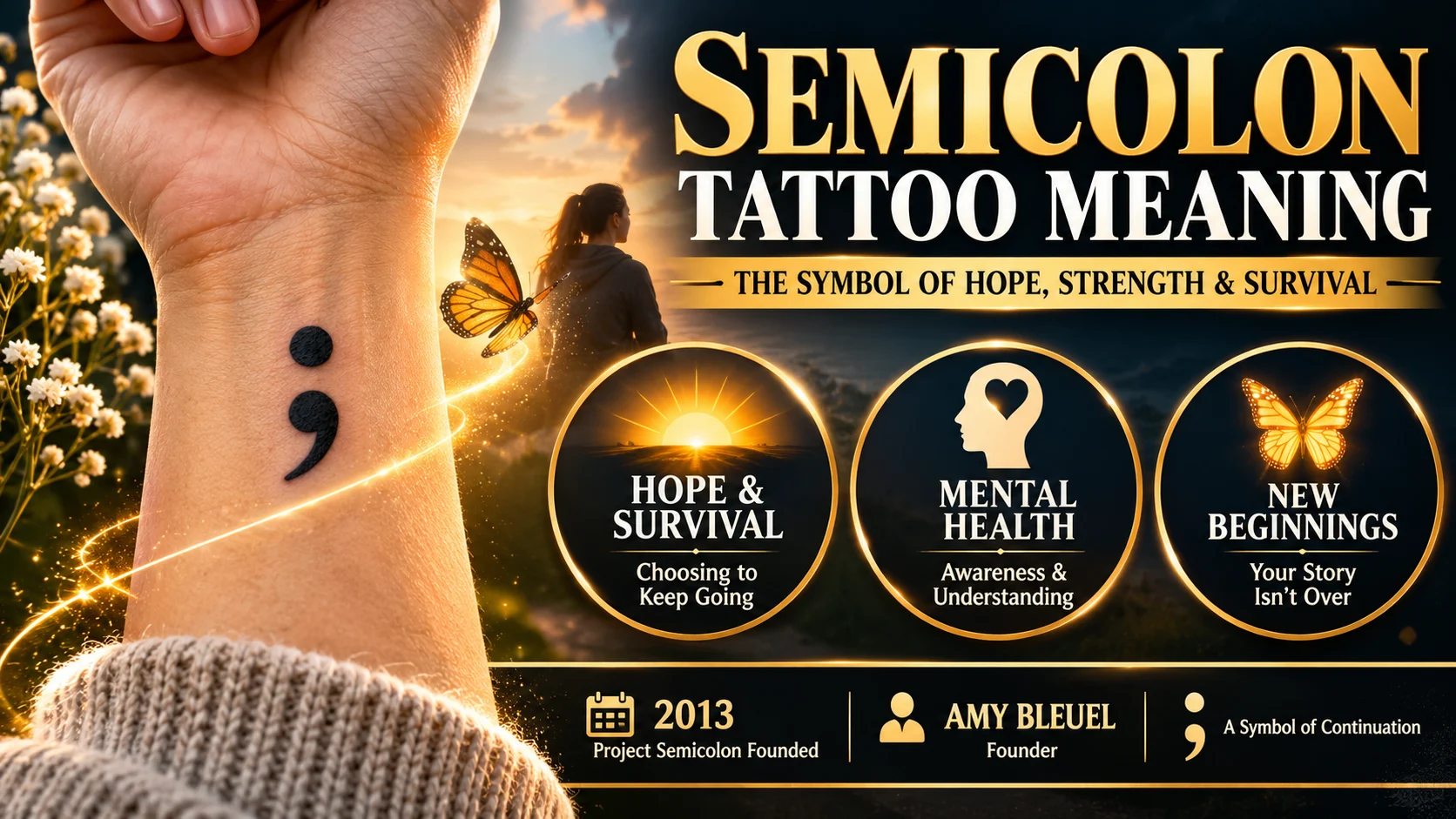
A semicolon tattoo generally represents hope, survival, and choosing to continue living despite difficult experiences. It is connected to the idea that an author could have ended a sentence with a period but chose a semicolon instead, allowing the sentence to continue. The symbol became widely associated with mental health awareness and suicide prevention through Project Semicolon, founded by Amy Bleuel in 2013. For many wearers, it serves as a personal reminder that their story is not over.
The Meaning Behind the Semicolon Symbol
To understand the symbolism, it helps to understand how a semicolon works in ordinary writing.
A semicolon (;) is a punctuation mark used to connect two closely related independent clauses. An independent clause is a group of words that can form a complete sentence on its own. Rather than separating the ideas with a full stop, a writer uses a semicolon to keep them connected.
For example:
“I faced difficult days; I chose to keep going.”
Both parts can stand as complete sentences, but the semicolon connects them.
This grammatical function provides the foundation for the tattoo’s symbolism. The first part of a person’s life may contain pain, loss, uncertainty, or experiences they never expected to face. However, those experiences do not have to determine how the rest of the story unfolds.
The writer represents the individual, while the sentence represents life.
That is why the semicolon is different from an ordinary motivational symbol. It does not suggest that life is always easy or that painful experiences disappear. Instead, it acknowledges that difficult moments can exist alongside the possibility of a future.
For some people, the message is about surviving a mental health crisis. For others, it represents recovering from addiction, dealing with grief, or finding the strength to begin again.
There is no requirement to explain the experience behind the tattoo. Its significance belongs to the person wearing it.
The History of Project Semicolon
The modern association between semicolons and mental health awareness began in 2013 with an initiative called Project Semicolon.
<PRIVATE_PERSON> founded the project after losing her father to suicide. She also drew on her own experiences with depression and other personal struggles. Her goal was to create a message that could encourage people facing emotional difficulties and help reduce the stigma surrounding mental health.
The central idea was straightforward: an author could have ended a sentence but decided to continue writing.
The same idea could represent a person who had experienced an extremely difficult period but still had a future ahead.
In April 2013, Bleuel encouraged people to draw semicolons on their wrists and share photographs on social media. The simple activity helped people participate in a shared message without needing elaborate campaigns or expensive materials.
The movement gradually reached a much wider audience. People began getting permanent semicolon tattoos, sharing their experiences, and using the symbol to show support for others.
ABC News reported in July 2015 that Bleuel estimated approximately one million people worldwide might have a semicolon tattoo at that time. This was her historical estimate, not a verified global count.
Bleuel died in March 2017. Her work, however, had already helped establish a recognizable symbol within mental health advocacy.
Today, Project Semicolon continues to communicate messages of hope, connection, and mental health awareness. Its history demonstrates how an everyday punctuation mark can become a shared expression of something deeply personal.
What a Semicolon Tattoo Represents
Although the symbol has a recognizable connection to mental health, different people attach different meanings to it. Understanding these interpretations helps explain why the design appeals to such a wide range of individuals.
1. Hope During Difficult Times
Hope is one of the most common interpretations.
People sometimes experience periods when their circumstances feel overwhelming. A small tattoo can serve as a reminder that difficult situations can change and that tomorrow may offer possibilities that are difficult to imagine today.
The mark does not promise an easy future. It represents the possibility of one.
2. Mental Health Awareness
The design is strongly associated with conversations about depression, anxiety, and other mental health challenges.
Some people wear it to acknowledge their experiences openly. Others use it to encourage more understanding and compassion toward people who may be struggling privately.
It can also help start conversations that might otherwise feel uncomfortable.
3. Survival and Personal Strength
For someone who has survived an especially difficult chapter, the tattoo can represent a personal milestone.
That chapter might involve emotional hardship, addiction recovery, trauma, or a period of major life disruption. The mark becomes a permanent reminder of the strength it took to reach a different stage of life.
It is not necessarily about celebrating suffering. It is about recognizing that suffering was not the entire story.
4. Remembering Someone Who Passed Away
Not every wearer gets the design to represent their own experiences.
Some people choose it in memory of a family member, friend, or partner who died by suicide. In these situations, it can represent love, remembrance, and a commitment to keeping that person’s memory alive.
It may also serve as a reminder to support people who are experiencing similar difficulties.
5. Support and Solidarity
A person does not need to have experienced depression or suicidal thoughts personally to appreciate the symbol.
Friends, relatives, partners, and mental health advocates sometimes choose it to show that they stand alongside people facing difficult circumstances.
For them, the tattoo communicates understanding and support rather than a personal account of survival.
Popular Semicolon Tattoo Designs and Their Meanings
One reason the design remains popular is its flexibility. It can be a small standalone mark or part of a larger piece of artwork.
The choice of style often adds another layer of personal significance.
| Tattoo design | Common interpretation |
|---|---|
| Simple black semicolon | Hope, continuation, and survival |
| Semicolon with a heart | Love, compassion, and emotional healing |
| Semicolon butterfly | Transformation and a new beginning |
| Semicolon with an infinity symbol | An ongoing journey and enduring hope |
| Semicolon with a flower | Growth, renewal, and personal development |
| Semicolon with a cross | Faith, spiritual strength, or remembrance |
| Semicolon with a meaningful word | A personal message or life reminder |
Minimalist Semicolon Tattoo
A simple black semicolon is one of the most recognizable versions. It usually consists of a small dot above a curved comma, without additional artwork.
Some people prefer this style because it keeps the original message intact. It can be placed on the wrist, ankle, behind the ear, or another location that feels personally meaningful.
Its simplicity also makes it easy to recognize.
Semicolon Butterfly Tattoo
A butterfly is often associated with transformation, change, and personal growth. When combined with a semicolon, it can represent moving through a difficult period and entering a new stage of life.
Some designs use the semicolon as the butterfly’s body, while others place the punctuation mark beside its wings.
This combination appeals to people who want their tattoo to communicate both survival and change.
Semicolon Heart Tattoo
A heart adds an element of love and emotional connection.
For some wearers, it represents self-love and learning to treat themselves with compassion. For others, it honors someone who provided support during a challenging period.
The combination can also symbolize kindness toward people dealing with invisible struggles.
Semicolon Infinity Tattoo
The infinity symbol represents something continuing without a defined endpoint. Combined with a semicolon, it can express an ongoing commitment to personal growth and the belief that life contains more chapters to come.
The two symbols are sometimes connected into one continuous design.
Semicolon Flower Tattoo
Flowers commonly represent renewal, beauty, and growth. A semicolon incorporated into a flower design can suggest that a person can develop and flourish even after experiencing difficult circumstances.
Roses, lavender, and small wildflowers are popular artistic choices, although their meanings depend on the wearer’s preferences.
Why the Symbol Matters in Mental Health Awareness
The semicolon became more than a tattoo trend because it helped make difficult conversations more visible.
Mental health struggles are not always obvious. Someone may appear comfortable at work, school, or social gatherings while privately dealing with emotional pain. This gap between outward appearance and internal experience can make it difficult for people to recognize when someone needs support.
A visible symbol can provide an opening for conversation.
For example, a person may notice the tattoo and ask about its meaning. If the wearer feels comfortable, that moment can lead to a discussion about mental health, personal experiences, or ways to support someone who is struggling.
However, the symbol should never be treated as a diagnosis.
A semicolon tattoo does not establish that someone has depression, has attempted suicide, or currently experiences suicidal thoughts. It may represent remembrance, friendship, advocacy, or something entirely different.
Respect matters here. Asking politely is very different from demanding that someone explain a deeply personal experience.
Organizations such as the National Institute of Mental Health (NIMH) and the World Health Organization (WHO) provide information about mental health conditions and suicide prevention. Their work also highlights the importance of awareness, early support, and access to appropriate care.
A tattoo can communicate a message, but it cannot replace professional treatment, supportive relationships, or crisis intervention.
That distinction is important. The symbol is most meaningful when it encourages understanding rather than becoming a substitute for real help.
Semicolon Tattoos Compared With Other Awareness Symbols
Semicolons are not the only visual symbols associated with mental health and personal recovery. Other designs communicate related messages, although their meanings are not identical.
| Symbol | Common association | Main difference |
|---|---|---|
| Semicolon (;) | Hope, continuation, and mental health awareness | Focuses on continuing one’s personal story |
| Green ribbon | Mental health awareness | Primarily communicates public awareness and advocacy |
| Butterfly | Transformation and personal growth | Focuses on change rather than a specific mental health movement |
| Lotus flower | Renewal, resilience, and spiritual growth | Often carries broader cultural and spiritual meanings |
| Infinity symbol | Continuity and enduring connection | Represents an ongoing journey without a specific mental health origin |
The green ribbon, for example, is widely recognized as a mental health awareness symbol. It is commonly used in educational campaigns and public awareness activities.
A butterfly, meanwhile, can represent a fresh start after a difficult experience without necessarily referring to depression or suicide prevention.
The semicolon has a more specific modern history because of Project Semicolon and its connection to conversations about suicide prevention.
These symbols can also be combined. A person might choose a semicolon with a butterfly or flower to express several aspects of their personal journey through one design.
Things to Consider Before Getting a Semicolon Tattoo
A tattoo is permanent, so choosing a meaningful design deserves some thought.
Although the semicolon is small, its associations can be emotionally significant. Here are several practical considerations before making a decision.
Choose a Design That Reflects Your Meaning
Think about what you want the tattoo to represent.
Is it a reminder of personal growth? A tribute to someone you miss? A symbol of support for mental health awareness?
Your answer can help determine whether a simple semicolon or a more detailed design feels appropriate.
Decide Where You Want It
Common placements include the wrist, forearm, ankle, shoulder, and behind the ear.
The wrist is particularly recognizable because it was used in early Project Semicolon social media activities. However, there is no official placement requirement.
Consider whether you want the design to remain visible or prefer a more private location.
Find an Experienced Tattoo Artist
Even a small punctuation tattoo requires precision.
A semicolon has two distinct elements: the upper dot and the curved lower mark. If these details are poorly executed, the design may become difficult to recognize.
Choose a reputable studio that follows proper hygiene practices and uses sterile equipment. Ask to see examples of the artist’s fine-line work before booking an appointment.
Think About the Emotional Meaning
For some individuals, getting this tattoo can be a positive and meaningful experience. Others may find that discussing its associations brings back difficult memories.
There is no need to rush the decision. You can sketch the design, use a temporary tattoo, or simply wait until you feel comfortable making a permanent choice.
Remember That You Do Not Owe Anyone an Explanation
A meaningful tattoo can remain private.
You may choose to discuss its significance with close friends or family, or you may prefer to keep the story entirely to yourself. Both choices are valid.
The purpose of the design is not to satisfy other people’s curiosity.
Frequently Asked Questions
1. Does a semicolon tattoo mean someone has depression?
Not necessarily. The symbol is associated with mental health awareness, but it does not reveal a person’s diagnosis or medical history. Someone may wear it for remembrance, solidarity, personal growth, or another private reason.
2. Is a semicolon tattoo religious?
No. The semicolon itself is a punctuation mark rather than a religious symbol. However, some individuals combine it with a cross or other spiritual imagery to express their personal beliefs.
3. Why is the semicolon tattoo often placed on the wrist?
The wrist became associated with the movement because early Project Semicolon participants drew semicolons on their wrists and shared photographs online in 2013. Permanent wrist tattoos later became a recognizable expression of the same message. Other placements are equally meaningful.
4. Is there an official color for a semicolon tattoo?
No single tattoo color is required. Black ink is common because it creates a simple, recognizable design. Some people choose blue, purple, green, or other colors to reflect their personal preferences or incorporate additional symbolism.
5. Can someone get a semicolon tattoo in memory of a loved one?
Yes. Many people use the symbol as a tribute to someone they lost, particularly someone who died by suicide. It can represent remembrance, love, and a desire to support greater understanding of mental health challenges.
6. Is Project Semicolon still relevant?
Yes. Project Semicolon continues to share messages about mental health, connection, hope, and personal stories. Its original message remains recognizable even as individuals have developed their own interpretations of the symbol.
Conclusion
A semicolon may be one of the smallest tattoo designs, but its message can carry enormous personal significance. For some, it represents surviving difficult experiences; for others, it honors a loved one or expresses support for mental health awareness. Its connection to Project Semicolon gave it a recognizable place in conversations about hope and suicide prevention. Ultimately, the meaning belongs to the person wearing it, and every person’s story deserves to be treated with compassion.

Jonathan Reed is a writer and blogger at NetWorthLink.com, turning complex ideas into clear, useful insights. He writes with curiosity, clarity and a focus on what readers can actually use.