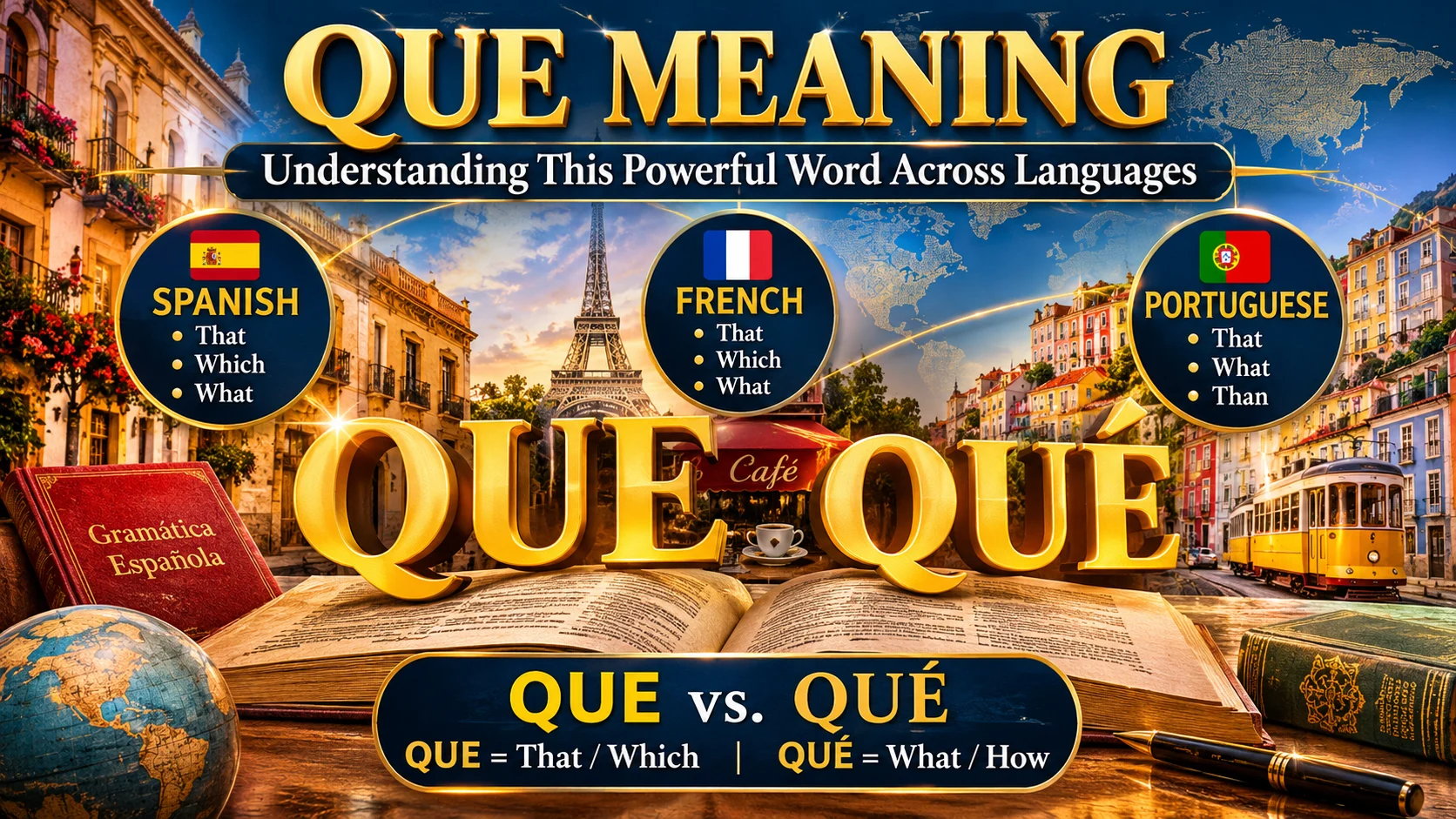
Que is a common word in several Romance languages, especially Spanish, French, and Portuguese. Depending on the language and context, it can mean that, which, who, or what. In Spanish, unaccented que commonly introduces statements and connects clauses, while accented qué is used in questions and exclamations to mean what or how. Its exact English translation depends on the sentence rather than the word alone.
What Does Que Mean in Spanish?
In Spanish, que is one of the most frequently used grammatical words. It performs several functions, including connecting clauses, introducing information, and referring to something previously mentioned.
Its English translation depends on the sentence.
Consider these examples:
| Spanish sentence | English translation | Function |
|---|---|---|
| Creo que tienes razón. | I think that you are right. | Connects clauses |
| El libro que compré. | The book that I bought. | Relative pronoun |
| Quiero que vengas. | I want you to come. | Introduces a subordinate clause |
| La persona que llamó. | The person who called. | Refers to a person |
| ¿Qué quieres? | What do you want? | Interrogative |
Notice that que does not always translate directly into English.
For example, English speakers might say, “I want you to come.” Spanish speakers say, “Quiero que vengas.” The word que connects the two parts of the sentence, even though English does not require a separate equivalent of it.
Que as a Conjunction
One of its most important grammatical functions is acting as a conjunction. A conjunction joins words, phrases, or clauses.
For example:
- Sé que estás ocupado. — I know that you are busy.
- Dice que viene mañana. — He says that he is coming tomorrow.
- Espero que todo salga bien. — I hope everything goes well.
In these sentences, que introduces information connected to the first part of the statement.
Que as a Relative Pronoun
The word can also function as a relative pronoun, referring back to a person, object, or idea already mentioned.
Examples include:
- La casa que compramos. — The house that we bought.
- El hombre que vive aquí. — The man who lives here.
- La película que vimos. — The movie that we watched.
This usage is especially important because it helps Spanish speakers build longer, more detailed sentences without repeating the same nouns.
Que vs. Qué: Understanding the Accent
One of the most common questions among Spanish learners is why the same word sometimes appears with an accent mark.
The difference is important. Spanish uses the written accent, called a tilde, to distinguish certain words that have similar spellings but different grammatical functions.
The Difference Between Que and Qué
| Feature | Que | Qué |
|---|---|---|
| Written form | No accent | Has an accent |
| Pronunciation | Unstressed | Stressed |
| Main function | Conjunction or relative pronoun | Interrogative or exclamatory word |
| Common translations | That, which, who | What, how |
| Example | Sé que vienes. | ¿Qué quieres? |
Examples of unaccented que:
- Me dijo que estaba cansado. — He told me that he was tired.
- El coche que compré es nuevo. — The car that I bought is new.
- Quiero que me escuches. — I want you to listen to me.
Examples of accented qué:
- ¿Qué pasó? — What happened?
- ¿Qué necesitas? — What do you need?
- ¡Qué bonito! — How beautiful!
- No sé qué decir. — I don’t know what to say.
The last example is particularly useful. Even though the sentence is not written as a direct question, qué retains its accent because it introduces an indirect question.
Does Qué Always Appear in a Question?
No. It can also appear in exclamations and indirect questions.
For example:
- ¡Qué sorpresa! — What a surprise!
- ¡Qué frío hace! — How cold it is!
- No entiendo qué quieres. — I don’t understand what you want.
A useful rule is to look at the function of the word rather than simply checking whether the sentence ends with a question mark.
The Real Academia Española (RAE) explains the distinction between relative que and interrogative or exclamatory qué in its grammatical resources. RAE+2
Common Spanish Expressions With Que
Spanish speakers use que in many everyday expressions. Learning these combinations can make conversations easier because their meanings are not always obvious from translating each word separately.
Here are some particularly useful examples.
¿Qué tal?
This is one of the most recognizable Spanish expressions.
It can mean:
- How are you?
- How is it going?
- How was it?
- What do you think?
Examples:
¿Qué tal estás? — How are you?
¿Qué tal la película? — How was the movie?
The expression is informal and commonly used when greeting someone or asking about an experience.
Porque, Por Qué, Porqué, and Por Que
These four forms look similar, but they have different grammatical purposes.
| Spanish form | Meaning | Example |
|---|---|---|
| Porque | Because | No fui porque estaba enfermo. |
| Por qué | Why | ¿Por qué lloras? |
| Porqué | The reason | No entiendo el porqué. |
| Por que | For which / because of which, depending on context | Esa es la razón por que luchamos. |
The distinction between porque and por qué is particularly important.
¿Por qué estudias español? means “Why are you studying Spanish?”
Estudio español porque me gusta. means “I study Spanish because I like it.”
The first asks for a reason, while the second provides one.
Para Que
The expression para que generally means “so that” or “in order that.”
Examples:
- Te llamo para que vengas. — I’m calling you so that you come.
- Estudio para que mis padres estén orgullosos. — I study so that my parents will be proud.
- Guarda dinero para que puedas viajar. — Save money so that you can travel.
In many Spanish sentences, para que is followed by a subjunctive verb, a verb form used for wishes, possibilities, purposes, and other non-factual situations.
Así Que
Así que means “so,” “therefore,” or “as a result.”
Examples:
- Está lloviendo, así que me quedaré en casa. — It’s raining, so I’ll stay home.
- Tengo trabajo, así que no puedo salir. — I have work, so I can’t go out.
It is a useful expression for connecting two related ideas.
Tener Que and Hay Que
These expressions communicate obligation or necessity.
Tener que means “to have to.”
- Tengo que estudiar. — I have to study.
- Tenemos que salir. — We have to leave.
Hay que means “one must,” “you have to,” or “it is necessary to.”
- Hay que trabajar. — You have to work.
- Hay que respetar a los demás. — People must respect others.
The distinction is that tener que usually identifies a particular person or group, while hay que expresses a more general requirement.
Que Meaning in French
The word que is not exclusive to Spanish. It is also an important grammatical word in French.
French uses it as a relative pronoun, conjunction, interrogative word, and in certain comparative constructions.
Depending on the sentence, its English translations include that, which, who, what, and than.
Que as a Relative Pronoun
In French, que connects a noun to additional information about it.
For example:
Le livre que j’ai acheté.
Translation: The book that I bought.
Another example:
La femme que j’ai rencontrée.
Translation: The woman whom I met.
Here, the word connects the person or object being discussed with an additional clause.
Que in French Questions
French also uses que to ask questions.
For example:
- Que veux-tu? — What do you want?
- Que fais-tu? — What are you doing?
- Qu’est-ce que c’est? — What is it?
The expression qu’est-ce que is especially common in spoken and written French. It is a standard way to construct questions.
Que as a Conjunction
It can introduce a clause that explains what someone thinks, believes, or knows.
Je pense qu’il est gentil.
Translation: I think that he is kind.
Notice that que becomes qu’ before a vowel sound in this example. This process is called elision, where a vowel is dropped to make pronunciation smoother.
The French dictionary from Cambridge Dictionary lists these relative, interrogative, and conjunction uses, along with comparative meanings. Cambridge Dictionary
Que Meaning in Portuguese
Portuguese also uses que in several grammatical situations. It is common in both Brazilian Portuguese and European Portuguese.
Its meanings include that, which, what, and than, depending on its role.
For example:
- O que é isso? — What is that?
- A casa que comprei. — The house that I bought.
- Penso que ele está certo. — I think that he is right.
- Ela é mais alta que eu. — She is taller than me.
Que as a Question Word
One common Portuguese construction is o que, which generally translates as “what.”
Examples:
O que você quer?
What do you want?
O que aconteceu?
What happened?
Que as a Relative Pronoun
It can also connect a noun with a description or additional information.
O livro que estou lendo é interessante.
Translation: The book that I am reading is interesting.
Que in Comparisons
Portuguese uses que to introduce the second part of certain comparisons.
For example:
Ele é mais velho que seu irmão.
Translation: He is older than his brother.
The Portuguese form quê also exists. Unlike ordinary que, it can function as an accented interrogative form or as a masculine noun referring to an unspecified quality or characteristic.
Cambridge’s Portuguese-English dictionary distinguishes between que and quê, including their different grammatical uses. English translation – Cambridge Dictionary+1
How to Use Que in Everyday Sentences
Understanding definitions is useful, but recognizing the word in real conversations is even more important.
The following examples demonstrate how it works in different situations.
| Situation | Example | English meaning |
|---|---|---|
| Sharing information | Creo que sí. | I think so. |
| Asking a question | ¿Qué quieres? | What do you want? |
| Describing something | El perro que ladra. | The dog that barks. |
| Expressing a wish | ¡Que tengas suerte! | Good luck! |
| Explaining a reason | No fui porque llovía. | I didn’t go because it was raining. |
| Showing necessity | Tengo que trabajar. | I have to work. |
| Connecting results | Estaba cansado, así que dormí. | I was tired, so I slept. |
A Short Conversation Example
Here is how these expressions might appear in a simple Spanish conversation:
Ana: ¿Qué haces mañana?
What are you doing tomorrow?
Carlos: Creo que voy al mercado.
I think I’m going to the market.
Ana: ¿Para qué?
What for?
Carlos: Necesito comprar comida porque tengo invitados.
I need to buy food because I have guests.
Ana: ¡Qué bien! Espero que tengas un buen día.
That’s great! I hope you have a good day.
This short exchange demonstrates several different functions of the word and its related expressions.
The best way to learn them is to notice how they connect ideas rather than treating every occurrence as a separate vocabulary item.
Que vs. Other Similar Words
Spanish learners sometimes confuse que with other short words because their English translations overlap.
However, each has a different grammatical purpose.
Que vs. Cual
Both words can appear in sentences involving choices or descriptions, but they are not interchangeable in every situation.
| Word | General meaning | Example |
|---|---|---|
| Que | That, which, who | El libro que leí. |
| Cuál | Which one, what | ¿Cuál prefieres? |
| Qué | What | ¿Qué quieres? |
For example:
- ¿Qué quieres comprar? — What do you want to buy?
- ¿Cuál quieres comprar? — Which one do you want to buy?
The first asks what someone wants, while the second asks them to select from available options.
Que vs. Quien
Both can refer to people, but their grammatical uses differ.
Que can refer to people or things:
- El hombre que trabaja aquí. — The man who works here.
- La mujer que conocí. — The woman I met.
Quien refers to people:
- La persona con quien hablé. — The person with whom I spoke.
- Quien llegue primero ganará. — Whoever arrives first will win.
In everyday Spanish, que is often the more general relative pronoun, while quien is useful in particular constructions referring to people.
Que vs. Como
These words have different primary meanings.
- Que: That, which, who.
- Cómo: How.
- Como: As, like, or I eat, depending on context.
Examples:
- Sé que estás aquí. — I know that you are here.
- ¿Cómo estás? — How are you?
- Como frutas todos los días. — I eat fruit every day.
The accent in cómo distinguishes its interrogative or exclamatory use from unaccented como.
Common Mistakes When Using Que
Even learners with a reasonable understanding of Spanish grammar make mistakes with this word. Most problems come from translating directly from English or overlooking accent marks.
Here are some mistakes to watch for.
1. Forgetting the Accent in Questions
Incorrect: ¿Que quieres?
Correct: ¿Qué quieres?
When the word introduces a direct question asking “what,” it needs the accent.
2. Adding an Accent to Every Que
Not every occurrence needs a written accent.
Incorrect: Creo qué tienes razón.
Correct: Creo que tienes razón.
In this example, the word connects two clauses rather than asking a question.
3. Confusing Porque and Por Qué
These expressions have different purposes.
- ¿Por qué estás aquí? — Why are you here?
- Estoy aquí porque quiero aprender. — I’m here because I want to learn.
Remember that por qué asks for a reason, while porque provides one.
4. Translating Every Que as What
This is a common mistake for beginners.
For example, translating El coche que compré as “The car what I bought” is incorrect.
The natural English translation is “The car that I bought.”
Always consider the complete sentence before choosing an English equivalent.
5. Ignoring Indirect Questions
A question does not always need a question mark in Spanish to require an accent.
For example:
No sé qué pasó.
Translation: I don’t know what happened.
The word qué remains accented because the sentence contains an indirect question.
Frequently Asked Questions
Is Que a Spanish word or a French word?
It is used in both languages, as well as Portuguese and other Romance languages. Its grammatical functions differ slightly between languages, although translations such as “that,” “which,” and “what” overlap.
What does que mean in texting?
In Spanish-language messages, que usually carries the same meaning it has in ordinary writing. However, informal conversations may use shortened spellings, abbreviations, or missing accent marks. The surrounding message is important for understanding the intended meaning.
Is Que pronounced the same in Spanish and French?
No. In standard Spanish, que is pronounced approximately “keh,” with a clear vowel sound. French que has a different pronunciation, commonly represented as /kə/, with a reduced vowel. Pronunciation also varies with speaking speed and regional accent.
Is Que masculine or feminine in Spanish?
The grammatical word que does not have masculine or feminine forms. It can refer to masculine nouns, feminine nouns, and plural nouns without changing its spelling.
For example, el libro que compré and la casa que compré both use exactly the same relative pronoun.
Can Que start a Spanish sentence?
Yes. It can introduce certain independent clauses, wishes, commands, and conversational expressions.
For example:
- ¡Que tengas suerte! — Good luck!
- ¡Que empiece la fiesta! — Let the party begin!
- Que no se te olvide. — Don’t forget.
The precise interpretation depends on the grammatical construction and context.
What does Que mean in Latin?
Spanish, French, and Portuguese developed from Latin, and the word que has a historical connection to Latin quid, meaning “what,” as well as the wider development of Romance-language grammatical forms. However, modern Spanish que should not be treated as having exactly the same grammatical function as every historical Latin form.
Final Thoughts
The word que demonstrates how much meaning a short grammatical word can carry. Its role changes across Spanish, French, and Portuguese, and even within Spanish, the difference between que and qué can completely change a sentence’s meaning.
Rather than memorizing a single translation, focus on recognizing how the word connects ideas, introduces questions, and refers to people or things. Once you understand those patterns, reading and speaking these languages becomes considerably easier.

Nicole Stewart is a writer and blogger at NetWorthLink.com, turning complex money topics into clear, practical insights. She enjoys exploring finance, wealth and everyday strategies that help readers make smarter decisions.