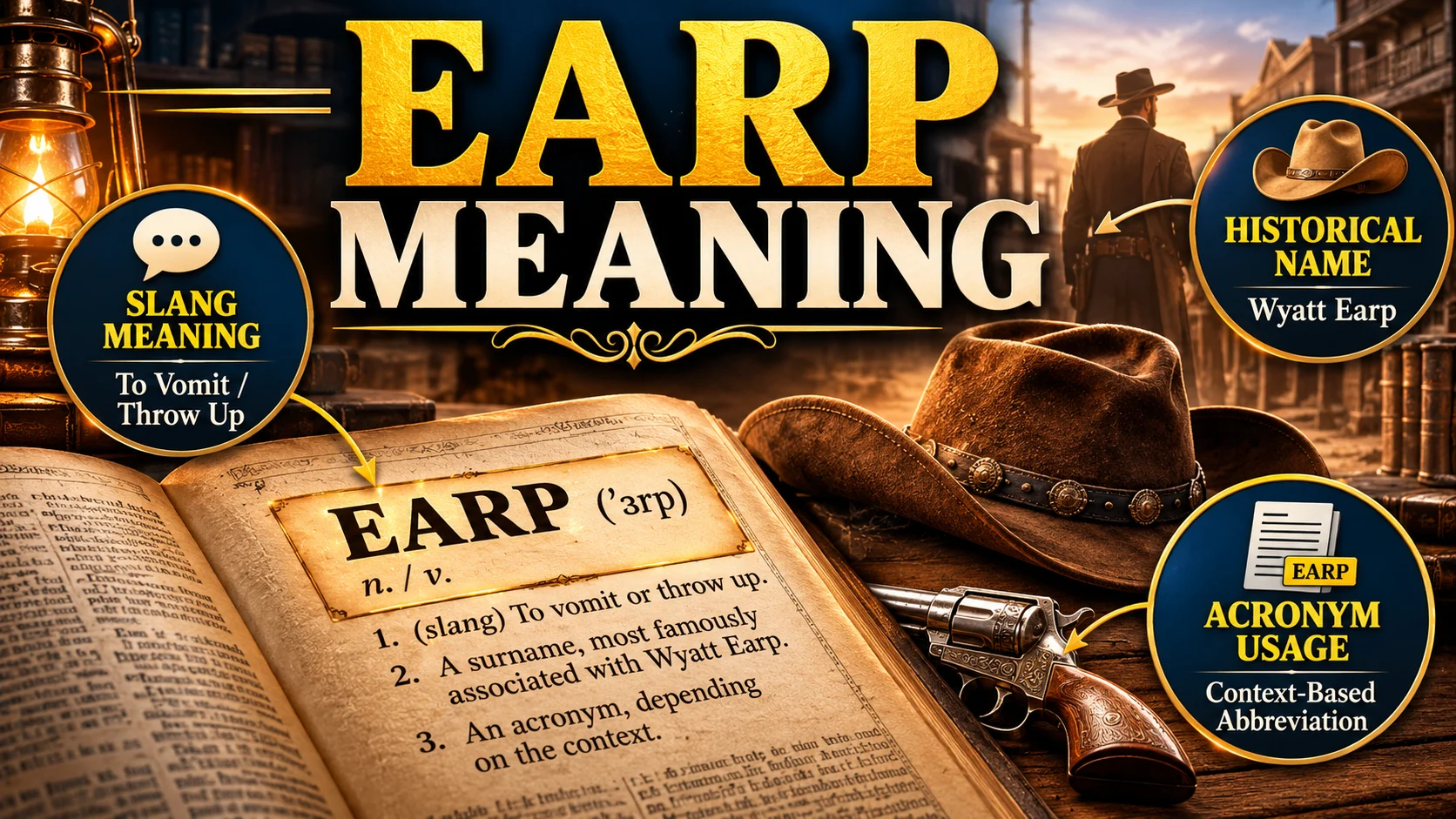
Earp is an uncommon English term with several context-dependent uses. In American slang, the related spelling “erp” or “earp” has been recorded as a verb meaning to vomit or throw up. It can also appear as a surname, most famously associated with American lawman Wyatt Earp. In professional and technical settings, EARP may represent an organization-specific abbreviation rather than a slang expression.
There is no universally accepted texting definition or standard internet acronym for EARP.
What Does Earp Mean?
The word has more than one possible interpretation, depending on where it appears.
One documented meaning comes from American teenage slang, where erp and earp are recorded as informal verbs meaning to vomit. The expression is considered echoic, meaning it imitates or resembles a sound associated with an action.
Think about the sounds people make when they feel nauseated. Informal expressions sometimes develop from these noises, eventually becoming recognizable words within particular communities.
However, this is not the only possible interpretation.
The spelling Earp is also a recognized surname. People familiar with American history may immediately associate it with Wyatt Earp, a well-known lawman of the American Old West.
In uppercase form, EARP can also function as an acronym. Its expansion depends on the organization, industry, or document where it appears.
| Usage | Meaning | Context |
|---|---|---|
| American slang | To vomit or throw up | Informal conversation |
| Surname | Earp family name | History and personal names |
| Technical abbreviation | Organization-specific full form | Professional documents |
| Online communication | Context-dependent expression | Texts and social media |
The important distinction is that these definitions belong to different language contexts. Someone reading a historical book will probably encounter the surname, while an old slang dictionary may use the word as a verb.
The Slang Meaning of Earp
The most interesting slang interpretation is its association with vomiting.
The Dictionary of Contemporary Slang, edited by Tony Thorne, records both “erp” and “earp” as American verbs meaning to vomit. It describes the expression as echoic and notes its use among teenagers of both sexes.
This gives the word a recognizable linguistic background, even though it is not common modern internet slang.
How Is It Used?
Imagine someone attending a party who suddenly feels sick after eating too much.
A person describing the situation might use an expression such as:
- “He started to earp after dinner.”
- “Someone earped outside the car.”
- “The smell was so bad that I almost earped.”
These examples illustrate the recorded slang sense rather than suggesting that the expression is widely used in everyday modern English.
Is Earp a Common Slang Word?
No. It is an uncommon expression.
Most English speakers would probably recognize more familiar alternatives, including:
- Vomit
- Throw up
- Puke
- Barf
- Hurl
These alternatives are much more recognizable in ordinary conversation.
If someone uses earp in a message today, you should not automatically assume they mean vomiting. The surrounding conversation may point to a completely different interpretation.
Pronunciation and Word Formation
Understanding how a word sounds can make unfamiliar vocabulary easier to recognize.
Earp is generally pronounced like “urp” or with a short vowel sound similar to the beginning of the English word “herd,” depending on accent.
It is a single-syllable expression.
The spelling can look unusual because English does not commonly use the letter combination “earp” in everyday vocabulary.
Why Is It Considered Echoic?
An echoic word imitates a sound or uses a sound associated with an action.
For example:
| Word | Sound or action represented |
|---|---|
| Buzz | Sound made by a bee or electrical device |
| Hiss | Sharp, continuous sound |
| Splash | Sound of liquid hitting a surface |
| Pop | Short, sudden bursting sound |
| Earp | Recorded slang associated with vomiting |
The relationship between sound and meaning is particularly interesting in informal vocabulary.
People often create playful expressions to describe uncomfortable, funny, or unpleasant experiences. Some disappear quickly, while others remain in regional speech or historical slang dictionaries.
The documented slang use of earp belongs to this broader pattern.
Earp as a Historical Surname
Not every appearance of Earp refers to slang.
One of the most recognizable people associated with this surname is Wyatt Earp.
6 Things You Should Know About Wyatt Earp | HISTORY
Wyatt Earp was an American lawman born in 1848 who died in 1929. He became associated with the history of the American frontier and the famous Gunfight at the O.K. Corral in Tombstone, Arizona.
His name has remained part of American popular culture through historical books, films, television productions, and Western stories.
Why Does This Matter?
Someone searching for Earp may not be looking for a slang definition at all.
For example:
- A history student may be researching Wyatt Earp.
- A film enthusiast may be discussing Western movies.
- A reader may have encountered the Earp family in a historical biography.
- Someone may simply be referring to a person with that surname.
The surname should not be confused with the slang verb.
The spelling is identical, but the meaning changes according to the sentence.
EARP as an Acronym
Another possible interpretation appears when the word is written entirely in capital letters.
EARP can represent different technical or organizational phrases.
There is no single universal expansion.
Two documented examples help illustrate why context matters.
Enhanced Actinide Removal Plant
In the United Kingdom’s nuclear industry, EARP stands for Enhanced Actinide Removal Plant.
It is associated with Sellafield, a major nuclear site in Cumbria, England.
The name appears in official environmental documentation, including material published through the UK government’s environmental regulatory system.
This is a specialized technical use, not a texting abbreviation.
Electronic Audience Reaction Polling
Another documented expansion is Electronic Audience Reaction Polling.
The abbreviation appears in an acronym glossary included in a Twin Cities metropolitan emergency-preparedness workshop report.
This example demonstrates how the same four letters can identify an entirely different process in another professional setting.
| Acronym | Full form | Context |
|---|---|---|
| EARP | Enhanced Actinide Removal Plant | Nuclear industry |
| EARP | Electronic Audience Reaction Polling | Audience feedback |
| EARP | Other organization-specific expansions | Depends on the source |
These examples should not be treated as interchangeable definitions. Always check the document or industry in which the abbreviation appears.
Earp vs. Similar English Expressions
People sometimes confuse unfamiliar slang with more recognizable English words.
Although several expressions can describe similar situations, their meanings and levels of formality differ.
| Expression | Meaning | Usage |
|---|---|---|
| Earp | Recorded slang for vomiting | Uncommon |
| Erp | Alternative recorded spelling associated with vomiting | Uncommon |
| Urp | Informal sound associated with burping or vomiting | Informal |
| Puke | To vomit | Casual |
| Barf | To vomit | Informal |
| Hurl | To vomit | Informal |
| Vomit | To bring stomach contents up through the mouth | Standard English |
Earp vs. Erp
These two spellings are particularly close.
The Dictionary of Contemporary Slang records both forms with the same general meaning. The spelling difference does not establish two separate slang definitions.
Earp vs. Puke
Both can describe vomiting, but their familiarity is very different.
Puke is widely understood in informal English. Earp is an unusual expression that most readers may need to look up.
Earp vs. Urp
Urp is another sound-based informal expression. It is often associated with burping or vomiting, depending on the source and context.
Although these expressions sound similar, they should not automatically be treated as identical words.
How to Understand Earp in Conversations
The best way to interpret an unfamiliar expression is to examine the surrounding sentence.
Capitalization, subject matter, and the people involved can provide useful clues.
Consider these examples.
Example 1: Informal slang
Person A: “He felt terrible after eating all that food.”
Person B: “Yeah, he nearly earped.”
Meaning: The speaker is using the uncommon slang sense associated with vomiting.
Example 2: Historical discussion
Person A: “I’m reading a book about Wyatt Earp.”
Person B: “His story is fascinating.”
Meaning: Earp is a surname referring to a historical figure.
Example 3: Workplace communication
Person A: “Please review the EARP documentation.”
Person B: “I’ll check it this afternoon.”
Meaning: EARP probably identifies a specific workplace process, project, or technical subject.
Example 4: Academic research
Person A: “The report includes an EARP reference.”
Person B: “Which expansion does the report use?”
Meaning: The abbreviation needs to be interpreted according to the document.
Notice something important: the word itself does not provide enough information to establish the intended meaning in every situation.
Common Misunderstandings
Because the expression is unusual, several mistakes can occur when people encounter it.
Assuming EARP Is a Popular Texting Abbreviation
There is no widely accepted internet definition that makes EARP equivalent to common abbreviations such as LOL or IDK.
Treating it as a standard texting expression can lead to misunderstandings.
Assuming Every Capitalized Version Has the Same Meaning
Writing all four letters in uppercase often suggests an acronym, but it does not identify which expansion is intended.
Different industries may use the same abbreviation for unrelated purposes.
Confusing the Surname With Slang
A reference to Wyatt Earp has nothing to do with the slang verb.
The surrounding sentence usually makes the distinction clear.
Assuming an Unusual Word Is a Typographical Error
Sometimes an unfamiliar spelling is simply an uncommon or historical expression.
However, mistakes are also possible. If the sentence does not make sense, consider whether the writer intended another word.
Frequently Asked Questions
1. Is Earp a real English word?
Yes. The spelling has documented uses in English, including a historical American slang verb and a recognized surname. It also appears in specialized abbreviations.
2. Is Earp an offensive word?
The recorded slang meaning is not inherently a swear word or insult. However, describing vomiting may be unpleasant or inappropriate in formal situations.
3. Is Earp used in modern texting?
It is not a widely established texting abbreviation. If you encounter it in a message, consider whether it refers to a person, a specialized acronym, or an uncommon slang expression.
4. Is Earp a noun or a verb?
It depends on the context. In the documented slang usage, earp is a verb. As a family name, Earp is a proper noun.
5. Does EARP have an official full form?
There is no universal full form. Different organizations use these letters for different purposes, including Enhanced Actinide Removal Plant.
6. Can I use Earp in formal writing?
Generally, avoid using the slang form in formal writing. Choose a clearer expression, such as “vomit,” if that is what you intend to communicate. Use EARP as an acronym only after defining its full form for readers.
Conclusion
Earp is an unusual English expression with more than one documented use. Its historical American slang meaning is associated with vomiting, while the surname is familiar through figures such as Wyatt Earp. In professional settings, EARP can also represent specialized organizational or technical terminology. Rather than assuming one definition applies everywhere, consider the sentence, subject, and situation before deciding what the writer means.

Stephanie Adams is a blogger and writer at NetWorthLink.com with a passion for meaningful, relatable content. She brings a simple, conversational style to every piece she writes.